Abstract
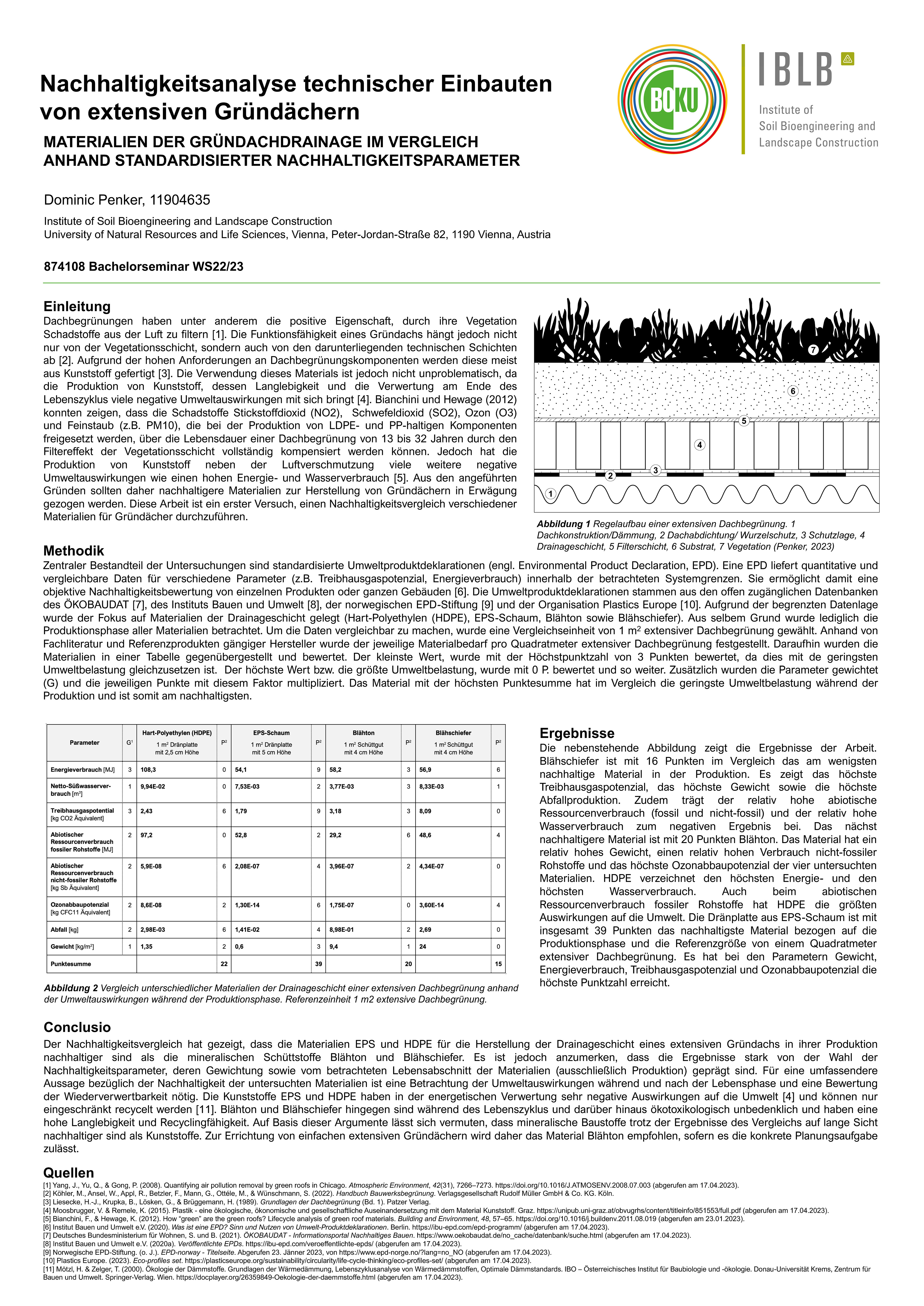
Green roofs are generally considered to be sustainable structures which, through the functioning of the vegetation, help to locally mitigate the consequences of the climate and biodiversity crisis. However, the sustainability of green roofs depends not only on the vegetation layer, but also on the materials of the technical components of a green roof. To meet the diverse structural requirements of green roof components plastics such as high density polyethylen (HDPE) or expanded polystyrene (EPS) are often used. However, due to their limited recyclability at the end of their life cycle, plastics are a problematic building material. Therefore, other materials should be considered for the construction of green roofs. This paper compares the sustainability of different green roof materials using internationally standardized parameters. The data are taken from openly available environmental product declarations. Due to the limited data available, only materials of the drainage layer (high density polyethylene (HDPE), expanded polystyrene (EPS), expanded clay and expanded shale) were investigated. In addition, the comparison was limited to the environmental impact of the production phase. The results show that, in relation to one square meter of extensive green roof, the materials EPS and HDPE are more sustainable than expanded clay and expanded shale during the production phase. The results of the comparison must be relativized however, because the environmental impact of the materials during and after their life cycle, as well as their recyclability, could not be included in the assessment due to methodological limitations. As a result, no confident statement can be made about the sustainability of the materials studied. However, it can be assumed that expanded clay and expanded shale are more sustainable than plastics in the long term when used as drainage layers due to their good recyclability and lack of ecotoxicity.